
Blog
Understanding the Real Difference Between MIT-A and 7-OH Kratom Extracts

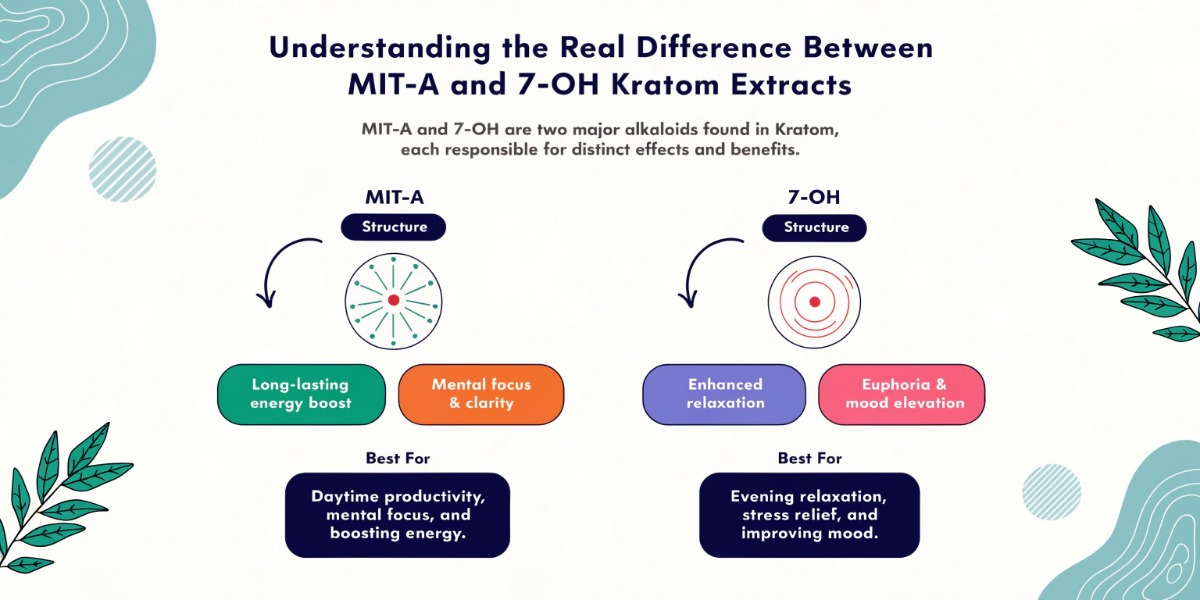
If you’ve spent any time researching kratom extracts, you’ve likely come across two names that show up repeatedly: Mitragynine (MIT-A) and 7-Hydroxymitragynine (7-OH). Both are alkaloids derived from the Mitragyna speciosa plant. Both are used in botanical extract products. But beyond that shared origin, the two are quite different — in their chemistry, their potency, their effect profiles, and how responsible brands approach their formulation.
This guide puts MIT-A and 7-OH side by side so you can understand exactly what you’re choosing between, what to look for on a label, and why the source and standard of your product matters just as much as the compound itself.
The Problem With Treating MIT-A and 7-OH as Interchangeable
A lot of consumers — and even some brands — lump MIT-A and 7-OH together under the broad umbrella of “kratom extract.” That’s like comparing a standard espresso shot to a triple-concentrated cold brew and calling them both just “coffee.” The category is the same. The experience is not.
When brands fail to distinguish between these two alkaloids on their labels, consumers lose the ability to make an informed choice. Vague descriptions like “full-spectrum extract” or “high-alkaloid blend” don’t tell you what’s actually in the product, at what concentration, or what to realistically expect. That kind of opacity is exactly what the kratom industry needs less of — and exactly what drives consumers toward brands that lead with transparency.
What Is Mitragynine (MIT-A)?
Mitragynine is the primary alkaloid in the Mitragyna speciosa plant. By dry weight, it typically comprises anywhere from 60% to 66% of the total alkaloid content in raw kratom leaf. Because it’s the dominant compound, it’s also the alkaloid most commonly associated with the broad effects of traditional kratom use.
MIT-A interacts with opioid receptors in the body, though its mechanism differs from classical opioids. Researchers have noted that it acts as a partial agonist rather than a full agonist — a distinction that matters in terms of effect profile and safety considerations.
Key characteristics of MIT-A:
- Most abundant alkaloid in the kratom plant
- Moderate effect potency relative to 7-OH
- Present in standard kratom powder, leaf, and most extract products
- Effect onset is generally gradual compared to more concentrated alkaloids
- More research exists on MIT-A than most other kratom compounds due to its prevalence
MIT-A is the baseline. It’s what most people experience when they use traditional kratom products. Products built around MIT-A tend to have a broader, less intense alkaloid profile.
What Is 7-Hydroxymitragynine (7-OH)?
7-Hydroxymitragynine is a different story entirely. Naturally, it occurs in the kratom plant at extremely low concentrations — typically less than 2% of total alkaloid content. But despite its scarcity, it’s widely considered to be significantly more potent than mitragynine at receptor sites.
When 7-OH is extracted and concentrated into a product format — like the Zero 7-OH Tablets offered by Hyroxi — the resulting extract carries a much stronger effect profile than anything derived from standard MIT-A-based kratom. That potency demands a fundamentally different level of precision in formulation.
Key characteristics of 7-OH:
- Minor alkaloid by natural occurrence, major alkaloid by potency
- Significantly stronger effect profile than MIT-A
- Requires precise, verified dosing — small deviations carry more consequence
- Products containing isolated or concentrated 7-OH require stricter quality standards
- Subject to heightened regulatory attention as the kratom industry evolves
Because 7-OH is so much more potent per milligram than MIT-A, any brand working with this alkaloid that isn’t publishing third-party lab results, maintaining dosing accuracy, and enforcing age verification is operating irresponsibly — full stop.
MIT-A vs 7-OH: A Direct Side-by-Side Comparison
| Feature | MIT-A | 7-OH |
|---|---|---|
| Natural abundance in kratom | High (60–66% of alkaloids) | Very low (under 2%) |
| Relative potency | Moderate | High |
| Effect onset | Gradual | More immediate |
| Common product formats | Powder, capsules, standard extracts | Concentrated tablets, specialized extracts |
| Precision dosing required | Moderate | High |
| Third-party testing importance | Important | Critical |
| Regulatory scrutiny | Moderate | Elevated |
| Suitable for first-time users | More accessible | Requires more research and caution |
Neither MIT-A nor 7-OH is inherently “better.” They serve different needs. The right choice depends on your experience level, your familiarity with kratom extracts, and — most importantly — the quality of the product and brand you’re purchasing from.
Why the Brand Behind the Alkaloid Matters
Whether you’re looking at a MIT-A product or a 7-OH product, the alkaloid itself is only part of the equation. The other part is everything that happens before the product reaches you: sourcing, formulation, testing, labeling, and distribution standards.
This is where Hyroxi MIT-A and the broader Hyroxi product line reflect a standard that goes beyond what most brands in this space commit to. As a family-owned, Georgia-based company, Hyroxi builds compliance into every stage of production — not as a regulatory checkbox, but as a baseline operating principle.
What that looks like in practice:
Third-party lab verification — Every product batch is tested by an independent laboratory. Results are published publicly on the website at hyroxi.life/lab-result. Not on request. Not behind a form. Publicly available before you purchase.
Precise, stated dosing — Hyroxi’s Zero 7-OH Tablets are formulated to deliver a clearly labeled 18mg per tablet, verified through the same third-party testing process. You know what you’re getting.
Clean formulation — No undisclosed additives. No vague “proprietary blends” that obscure what’s actually in the product. What’s on the label reflects what’s in the tablet.
Age-gated sales — Hyroxi enforces a 21+ age requirement across all purchases. This is applied meaningfully, not symbolically.
Geographic compliance — Hyroxi does not ship to states and municipalities where kratom is prohibited, including Alabama, Arkansas, Indiana, Rhode Island, Vermont, Wisconsin, and localities with local restrictions.
Dosing Considerations: MIT-A vs 7-OH
Because of the potency gap between these two alkaloids, dosing approaches differ significantly.
With MIT-A-dominant products, consumers often work with larger quantities to achieve desired effects — a natural consequence of the alkaloid’s moderate potency at standard concentrations. The experience tends to be more graduated and forgiving in terms of dose sensitivity.
With 7-OH products, less is more — and precision matters significantly. An 18mg 7-OH tablet is a clearly defined, lab-verified dose. Attempting to estimate or approximate dosing with concentrated 7-OH products through unreliable sourcing introduces unnecessary risk. This is one of the clearest practical arguments for choosing verified, transparently labeled 7-OH products over cheaper, unlabeled alternatives.
General guidance for consumers:
- If you’re new to kratom extracts, understand the alkaloid profile of any product before purchasing
- Always look for third-party lab results — not just claims of lab testing
- Start with the minimum stated dose and assess response before adjusting
- Give adequate time between uses to properly gauge effects
- Never use kratom extract products if you are under 21 or if kratom is prohibited in your state or locality
The Kratom Consumer Protection Act and What It Means for Both Alkaloids
The Kratom Consumer Protection Act (KCPA) is a model legislative framework that has been adopted in a growing number of US states. It sets minimum standards for kratom products, including labeling requirements, contaminant limits, and age restrictions.
Notably, the KCPA applies across the kratom product spectrum — including products containing concentrated alkaloids like 7-OH. Brands that operate in alignment with KCPA principles, regardless of whether their state has formally enacted the legislation, are positioning themselves responsibly as the regulatory landscape continues to develop.
Hyroxi’s practices across both its MIT-A and 7-OH product lines reflect KCPA-aligned standards: accurate labeling, age verification, third-party testing, and geographic compliance. As federal and state scrutiny on kratom extracts increases — particularly around concentrated and high-potency products — this kind of compliance infrastructure won’t be optional. It will be the floor.
How to Make the Right Choice for You
The MIT-A vs 7-OH decision isn’t about which alkaloid is “stronger” or “better.” It’s about matching the product to your level of experience, your knowledge of what you’re consuming, and your confidence in the brand delivering it.
Ask yourself these questions before any purchase:
- Does the product have published, third-party verified lab results?
- Is the alkaloid type and dosage clearly and specifically stated on the label?
- Does the brand enforce age verification and geographic compliance?
- Is the sourcing transparent, or is the supply chain invisible?
- What happens if you have a question — is there a real company with visible accountability behind the product?
If a product can’t answer those questions, that’s your answer.
Ready to See the Standard for Yourself?
If you’re ready to explore either alkaloid format from a brand that puts documentation ahead of marketing language, Hyroxi’s product lineup covers both — with the same commitment to transparency across the board.
Shop Hyroxi Zero 7-OH Tablets: https://hyroxi.life/shop/