
Blog
MU Receptors & Kratom: How MIT-A Hits the Same Pathways

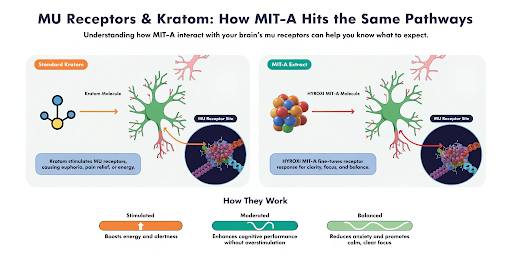
Most kratom conversations stay at the surface level — strain names, powder versus extract, duration claims, and price per unit. What often goes unexplored is the underlying mechanism that actually drives the experience. Why MIT-A extract behaves differently. Why the effects feel functional rather than overwhelming. And why experienced users consistently describe it as a distinct category altogether.
That mechanism begins at the mu opioid receptor — and once you understand how hyroxi mit-a interacts at this level, it changes the way you think about everything from dosing and duration to why verified alkaloid content matters more than any other product specification.
What MU Receptors Actually Are
The human body has a system of opioid receptors distributed throughout the brain, spinal cord, and peripheral nervous system. These receptors — classified as MU, Kappa, and Delta — are part of the endogenous opioid system, the same system that processes naturally occurring compounds like endorphins.
MU receptors are the primary target. They regulate a broad range of functions:
- Pain modulation — MU receptor activation reduces the perception of pain signals traveling through the nervous system
- Mood and reward processing — MU activation influences dopamine pathways, producing feelings of wellbeing and motivation
- Relaxation and sedation — at higher activation levels, MU receptor engagement produces sedative effects
- Anxiety reduction — partial activation of MU receptors produces calming effects without full sedation
The MU receptor is also the primary target of classical opioid compounds — which is why the conversation about kratom’s mechanism inevitably involves this receptor class. The difference between how classical opioids and Mitragynine engage MU receptors is not just a detail. It’s the entire story.
How Mitragynine Engages MU Receptors Differently
Classical opioid compounds — morphine, oxycodone, fentanyl — are full agonists at MU receptors. They bind to the receptor and activate it completely, producing the full range of effects the receptor is capable of generating at maximum intensity.
Mitragynine — the primary active alkaloid in kratom and the compound in MIT-A extract — is a partial agonist. That distinction has specific, measurable implications for the effect profile it produces.
Here’s what partial agonism means in practice:
- Binding without full activation — Mitragynine binds to MU receptors and activates them, but does not drive receptor activation to maximum capacity. The effect produced is real and functional — but it operates within a ceiling that full agonists don’t have.
- Lower ceiling on sedation — Because partial agonists don’t fully activate MU receptors, the sedative effects associated with high-level MU activation are less pronounced. This is why MIT-A extract users report functional clarity rather than impairment — the receptor pathway is engaged but not saturated.
- More gradual dose-response curve — Partial agonists produce effects that scale with dose in a more manageable way than full agonists. Within the functional dose range, increasing the dose produces more effect. But the curve flattens before reaching the extreme activation levels full agonists can achieve.
- Different interaction with receptor tolerance — Partial agonism interacts with receptor tolerance differently than full agonism. This is an area of ongoing research, but the partial agonist mechanism is one reason experienced users report a different tolerance development profile with MIT-A extract than with full agonist compounds.
Why Partial Agonism Produces the MIT-A Effect Profile
The effect profile that MIT-A extract users describe — calm energy, sustained focus, relaxed clarity, functional mood elevation — is a direct product of partial MU receptor agonism operating within the functional dose range.
Each element of that profile maps to the receptor mechanism:
- Calm energy rather than stimulation — MU receptor partial activation engages the mood and motivation pathways without the sympathetic nervous system activation that produces jitteriness or anxiety. The energy is receptor-mediated, not stimulant-driven.
- Sustained focus rather than peak and crash — Partial agonists engage receptors more gradually and disengage more gradually than full agonists. That pharmacokinetic profile produces a steadier, longer-lasting effect window — which is why MIT-A extract consistently outperforms standard kratom powder on duration.
- Relaxed clarity rather than sedation — Because partial agonism doesn’t drive MU receptors to full activation, the sedative end of the MU receptor response remains subdued within the functional dose range. Users get the calming effect without the cognitive impairment.
- No sharp crash — Full agonist compounds produce rebound effects when they clear receptor sites — a drop that users experience as a crash. Partial agonists disengage more gradually, producing a natural tapering rather than a sharp comedown.
That profile is not incidental. It is the pharmacological consequence of how Mitragynine interacts with MU receptors — and it’s why the effect profile of MIT-A extract is structurally different from both classical opioids and standard stimulants.
Why Verified Dosing Is Inseparable From Receptor Science
Understanding MU receptor partial agonism makes one thing immediately clear: dose determines everything.
Partial agonists operate within a functional window. Below that window, receptor engagement is insufficient to produce meaningful effects. Within it, the effect profile described above materializes. Above it, the balance shifts — sedation becomes more dominant, clarity fades, and the functional advantage of partial agonism is lost.
That window exists because of receptor biology. Hitting it consistently requires one thing: knowing exactly how much active alkaloid is in the product.
This is why verified dosing is not a secondary feature of a quality MIT-A extract — it’s the mechanism by which the receptor science actually translates into a reliable user experience:
- An underdosed tablet doesn’t reach the functional window. MU receptor engagement is insufficient. The effect profile doesn’t materialize. The product fails.
- An accurately dosed tablet hits the window consistently. The partial agonist mechanism produces the effect profile. The experience is what the label implies.
- An overdosed tablet pushes past the functional window. Sedation dominates. The clarity advantage disappears.
Hyroxi mit-a tablets are formulated around this reality. Every batch is independently tested to confirm that the 28mg of active alkaloid stated on the label is the 28mg present in the tablet — not an estimate, not an average, but a verified quantity tied to the specific production run. Results are published publicly at hyroxi.life/lab-result.
What This Means for Retail Buyers
The MU receptor science isn’t just background information. It has direct implications for how you communicate MIT-A extract to customers and why the product performs the way it does at the retail level.
Here’s what understanding the receptor mechanism means for your display:
- Confident product explanation — When customers ask why MIT-A extract feels different from standard kratom or other botanicals, the partial agonist mechanism is a concrete, credible answer. It’s not marketing language — it’s pharmacology.
- Dosing accuracy as a selling point — Once customers understand that partial agonism operates within a functional window, verified dosing becomes an obvious differentiator. A product that hits the window consistently is worth paying more for.
- Duration as a receptor outcome — The longer duration of MIT-A extract isn’t a vague claim. It’s a predictable consequence of how partial agonists engage and disengage from MU receptors. That explanation resonates with experienced kratom users immediately.
- Effect profile differentiation — Calm energy, sustained focus, no crash — these aren’t arbitrary marketing benefits. They map directly to the receptor mechanism. Staff who understand that connection communicate the product with genuine authority.
What Retail Buyers Should Require From Any MIT-A Supplier
The receptor science only translates into a reliable retail product when the supplier behind it meets a genuine verification standard. When evaluating MIT-A extract suppliers, these are the non-negotiables:
- Published third-party COA on every batch — alkaloid content independently confirmed, not manufacturer-reported. Hyroxi publishes all results at hyroxi.life/lab-result
- Explicitly stated active alkaloid per tablet — a specific milligram number tied to lab documentation, not potency language
- Full contaminant screening — heavy metals, microbial presence, residual solvents. The MU receptor pathway is sensitive — what isn’t in the tablet matters as much as what is
- Batch-specific documentation — current results tied to current inventory. Receptor science requires consistent dosing. Consistent dosing requires batch-specific verification
- Compliance infrastructure — 21+ age verification, geographic restrictions, KCPA-aligned labeling. These protect your store and your customers equally
Final Thoughts
MIT-A extract hits the same receptor pathways that the body uses to process its own naturally occurring opioid compounds — but it does so as a partial agonist, producing a functional effect profile that full agonists can’t replicate and standard kratom powder can’t deliver consistently.
The calm energy, sustained focus, relaxed clarity, and clean finish that MIT-A users describe aren’t marketing benefits. They’re pharmacological outcomes — direct consequences of how Mitragynine engages MU receptors within a verified dose range.
Understanding that mechanism is what separates a retail buyer who stocks kratom from one who stocks it with genuine confidence.
The lab results are public. The dosing is verified. The receptor science is real.
Ready to Stock? Explore wholesale display options at: https://hyroxi.life/shop/