
Blog
Why COA Lab-Tested Mitragynine Tablets Are Worth Paying For

There’s a conversation happening at nearly every kratom display counter. A customer picks up a premium mitragynine tablet, notices the higher price, and naturally asks: why does this cost more than the powder sitting right next to it?
The answer isn’t packaging. It isn’t branding. And it’s definitely not marketing dressed up as quality.
The real answer lies in a Certificate of Analysis — and understanding what that document actually proves is what separates an average product from something like hyroxi mit-a, a truly verified kratom product.
What a COA Actually Is — And What It Isn't
A Certificate of Analysis is a formal document issued by an independent third-party laboratory confirming the chemical composition of a specific product batch. For mitragynine tablets, a legitimate COA confirms two things above everything else:
- What’s in the tablet — the actual alkaloid content, measured in milligrams, compared against the label claim
- What isn’t in the tablet — contaminant screening for heavy metals, microbial presence, residual solvents, and other substances that have no place in a product meant for human consumption
What a COA is not: a manufacturer’s internal quality report. A one-time historical test applied to all future batches. A summary in a marketing brochure. A QR code that leads to a certificate with no batch-specific information.
A legitimate COA is batch-specific, laboratory-issued, and publicly accessible. If any of those three elements are missing, the document isn’t doing what a COA is supposed to do.
The Problem With Untested Mitragynine Tablets
To understand why COA-tested tablets are worth paying for, it helps to understand exactly what you’re accepting when you stock a product without one.
Mitragynine concentration in untested kratom extract products is an assumption — not a measurement. The label may state a specific milligram quantity. Without independent lab verification, that number reflects what the manufacturer believes or claims is in the product. Not what’s actually there.
The consequences of that gap are specific and predictable:
- Underdosed tablets produce weak, inconsistent effects. Customers who don’t feel what they expected don’t blame the label — they blame the store that sold it to them. They don’t come back.
- Overdosed tablets push the experience past the functional range. Effects become uncomfortable rather than beneficial. That’s not a repeat purchase customer — that’s a complaint and potentially a return.
- Contaminant exposure is a risk that untested products carry by definition. Heavy metals, microbial contamination, and residual solvents from extraction processes are real concerns in any concentrated botanical product. A COA confirms they’re not present. The absence of a COA confirms nothing.
- Batch inconsistency means even if one lot of an untested product delivers a good experience, the next lot may not. Customers who had a positive first experience return and get something different. That’s a retention problem that no amount of shelf placement fixes.
What COA Verification Actually Costs — And What It Returns
The price premium on COA-tested mitragynine tablets reflects something real: the cost of doing verification correctly.
Independent laboratory testing is not cheap. Batch-specific analysis, alkaloid quantification, full contaminant panels — these represent a genuine investment per production run. Suppliers who absorb that cost and publish the results are making a specific commitment: that the product in the bottle matches the label on the outside, confirmed by a party with no financial interest in the outcome.
That commitment has a return — for the consumer and for the retailer:
- For the consumer — every tablet delivers what the label states. The experience is predictable. The decision to repurchase is easy.
- For the retailer — every unit stocked is a unit you can stand behind. Customer complaints drop. Staff recommendations become confident rather than qualified. The repeat purchase rate reflects product performance, not marketing.
The price premium on a COA-tested mitragynine tablet is not a margin grab. It’s the cost of certainty — passed through to the buyer in the form of a product that actually does what it says.
The Science That Makes Verified Dosing Matter
Mitragynine’s effect profile is dose-dependent in ways that make accuracy non-negotiable. It operates as a partial agonist at mu-opioid receptors — meaning the effects it produces are directly tied to the quantity of active compound engaging receptor sites.
Here’s what dose variance does to that interaction:
- Too little mitragynine — receptor engagement is insufficient to produce meaningful effects. The experience is weak or absent. The product fails the user.
- Correct dose range — receptor engagement reaches the functional threshold. The partial agonist pathway produces the effect profile the user came for — calm focus, sustained energy, relaxed clarity — depending on formulation and individual factors.
- Too much mitragynine — engagement tips past the functional range. Sedation dominates. The experience becomes counterproductive.
The margin between these ranges is real but not enormous. A verified COA means the dose stated on the label is the dose in the tablet — which means the user can make an informed decision about serving size. An unverified product removes that ability entirely. The user is guessing. And in a dose-dependent interaction, guessing is not a product feature.
Why Hyroxi MIT-A Sets the Standard
Not every COA is created equal — and not every supplier treats lab verification as a genuine commitment rather than a box to check.
Hyroxi mit-a tablets represent what COA verification looks like when it’s treated as a foundation rather than an afterthought:
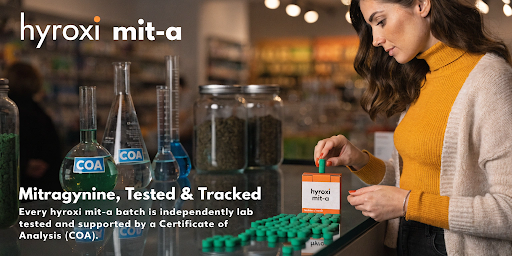
- Every batch is tested by an independent third-party laboratory — not internal QC, not a partner facility, but a genuinely independent analytical lab
- Results are published publicly at hyroxi.life/lab-result — not available on request, not summarized in marketing materials, but accessible to any buyer, retailer, or consumer before purchase
- Batch-specific documentation ties current inventory to current test results — not a historical certificate used across multiple production runs
- The 28mg active alkaloid stated on the label is the 28mg confirmed in the lab — independently measured, consistently delivered
That’s what COA verification looks like when it’s real. And that’s the standard retail buyers should require from every mitragynine tablet supplier they consider.
What This Means for Retail Buyers
Stocking COA-tested mitragynine tablets isn’t just a quality decision. It’s a business decision — one with direct implications for customer retention, staff confidence, and display category performance.
Here’s what carrying verified mitragynine tablets means for your retail operation:
- Defensible product recommendations — When a customer asks why this product costs more, your staff has a specific, credible answer. A COA is a document. It’s not a claim — it’s proof.
- Higher repeat purchase rates — Consistent dosing produces consistent experiences. Consistent experiences produce loyal customers. Loyal customers drive revenue more reliably than any promotional effort.
- Reduced complaint and return exposure — Verified dosing eliminates the primary source of kratom customer complaints: inconsistent effects. Fewer complaints mean less time managing problems and more time selling.
- Premium display positioning — COA-tested tablets occupy the top tier of any kratom display naturally. That positioning supports premium pricing, stronger per-unit margins, and a display category that signals quality to every customer who engages with it.
Supplier relationship confidence — A supplier who publishes batch-specific COA results is a supplier who stands behind their product at a level most competitors don’t. That confidence transfers to your buying decisions and your inventory planning.
What Retail Buyers Should Require From Any Mitragynine Tablet Supplier
The COA standard only protects your display when the verification behind it is genuine. When evaluating mitragynine tablet suppliers, these are the non-negotiables:
- Batch-specific third-party COA on every production run — not a historical certificate, not an internal document, but a current, independent laboratory result tied to the specific inventory you’re stocking
- Publicly accessible results — not available on request, publicly posted so any buyer or consumer can verify independently. Hyroxi publishes all results at hyroxi.life/lab-result
- Explicit active alkaloid content per tablet — a specific milligram number confirmed by the COA, not potency language or extract ratio claims
- Full contaminant panel — heavy metals, microbial screening, residual solvents. A COA that only confirms alkaloid content without contaminant screening is an incomplete document
- Compliance infrastructure — 21+ age verification enforcement, no shipment to prohibited states, KCPA-aligned labeling. These protect your store as much as the COA protects your customers
Final Thoughts
COA lab-tested mitragynine tablets cost more because they are more — more verified, more consistent, more reliable, and more defensible at the point of sale than any unverified alternative.
The price premium isn’t arbitrary. It reflects the real cost of doing product verification correctly — and it returns that cost to retailers and consumers in the form of a product that performs exactly as labeled, every batch, every time.
The lab results are public. The dosing is verified. The standard is non-negotiable.
Ready to Stock? Explore wholesale display options at: https://hyroxi.life/shop/